
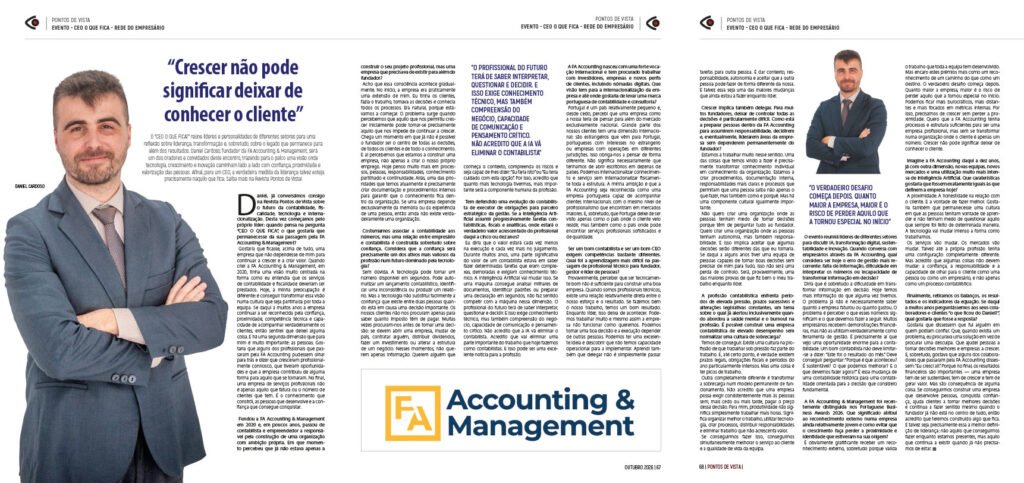
“Growth cannot mean losing touch with the client”
“CEO WHAT REMAINS?” brings together leaders and personalities from different sectors for a reflection on leadership, transformation and, above all, the legacy that remains beyond results. Daniel Cardoso, founder of FA Accounting & Management, will be one of the speakers and guests at this event, bringing to the stage a vision where technology, growth and innovation go hand in hand with trust, proximity and people-centered values. After all, for a CEO, the true measure of leadership may well lie in what remains. Learn more in Pontos de Vista Magazine.
“What remains beyond the numbers?”
1. Daniel, we have already spoken with you in Pontos de Vista Magazine about the future of accounting, taxation, technology and internationalization. This time, we begin with the leader himself: when you think about the question “CEO WHAT REMAINS?”, what would you like to endure from your time at FA Accounting & Management?
Above all, I would like a company to remain that does not depend on me to continue growing and creating value.
When I founded FA Accounting & Management in 2020, I had a vision very much centered on how I believed accounting and tax services should be delivered. Today, my concern is different: transforming that vision into a culture shared by the entire team.
If, many years from now, the company continues to be recognized for trust, closeness, technical expertise and its ability to genuinely support clients, then I will feel that I have left something meaningful behind.
There is also a second dimension that is very important to me: people. I would like some of the professionals who have been part of FA Accounting to look back and say that they grew professionally with us, that they were given opportunities, and that the company contributed in some way to who they became.
In the end, a professional services firm is not only defined by its revenue or number of clients. It is defined by the knowledge it builds, the people it develops and the trust it earns.
2. You founded FA Accounting & Management in 2020 and, within a few years, went from accountant and entrepreneur to the person responsible for building an organization with ambitions of its own. At what point did you realize that you were no longer simply building your own professional project, but a company that needed to exist beyond its founder?
I think that awareness develops gradually.
In the beginning, the company was practically an extension of myself. I had the clients, did the work, made the decisions and knew every process. That was natural because we were just getting started.
The challenge comes when you realize that what initially allowed you to grow can eventually become the very thing that prevents further growth.
There comes a point when the founder can no longer be at the center of every decision, every client and all knowledge. That is when you realize you are building a company rather than simply creating a job for yourself.
Today, I think much more about processes, people, responsibilities, shared knowledge and continuity.
In fact, one of our current priorities is creating internal documentation and procedures to ensure that knowledge remains within the organization. If a company depends exclusively on the memory or experience of one person, then it is not yet truly an organization.
3. Accounting is often associated with numbers, but the relationship between a business owner and an accountant is built primarily on trust. Do you believe trust will be one of the profession’s most valuable assets in a future dominated by technology?
Without a doubt.
Technology can make a number available in seconds. It can automate accounting entries, identify inconsistencies or generate reports.
What technology cannot easily replace is the trust that exists between two people when an important decision is at stake.
Our clients do not come to us just to find out how much tax they have to pay. Very often, they come to us before making a decision: whether to open a company, move to another country, hire someone, distribute dividends, make an investment or change a business structure.
In those moments, they are not just looking for information. They want someone who understands the context, recognizes the risks and can honestly say, “I would do this” or “I would be careful with that option.”
That is why I believe that the more technology we have, the more important the human side of the profession will become.
4. You have advocated for the evolution of accountants from compliance executors to strategic business partners. If Artificial Intelligence progressively takes over accounting, tax and analytical tasks, where will the real added value of the professional lie in five or ten years?
I would say the value will increasingly lie less in execution and more in judgment.
For many years, a significant part of an accountant’s value came from being able to perform tasks that were complex, time-consuming and highly technical.
Artificial Intelligence will change that.
If a machine can analyze thousands of documents, identify patterns or prepare a tax return in seconds, there is no point in competing with the machine on those terms.
The professional of the future will need to know how to interpret, question and decide.
That requires technical expertise, but also business understanding, communication skills and critical thinking.
I do not believe AI will eliminate accountants. I believe it will eliminate a significant portion of the work accountants currently perform.
And that could be excellent news for the profession.
5. FA Accounting was founded with a strong international focus and has sought to work with investors, companies and new client profiles, including digital nomads. What is your vision for the company’s international expansion, and how far would you like to take a Portuguese accounting and consulting brand?
Portugal is a relatively small country and, from an early stage, I realized that a company like ours needed to think beyond the domestic market.
A large share of our clients have an international dimension: foreigners moving to Portugal, Portuguese individuals with interests abroad, or companies operating across multiple jurisdictions.
That requires a different mindset.
It does not necessarily mean opening offices in dozens of countries. We can internationalize knowledge and services without physically expanding the entire structure.
My ambition is for FA Accounting to be recognized as a Portuguese company capable of supporting international clients with the same level of professionalism they would find in larger markets.
Above all, I want Portugal to be seen not only as the country where a client chooses to live, but also as a country where sophisticated, high-quality professional services can be found.
6. Being a good accountant and being a good CEO require very different skills. What was the most difficult lesson in the transition from technical professional to founder, manager and people leader?
Probably realizing that being technically good is not enough to build a great company.
As technical professionals, there is usually a direct relationship between effort and results. If we do our work well, we achieve a good outcome.
As a leader, it no longer works that way.
You can work very hard and still not have the company operating as you would like. You can make the right decision and depend on others for execution. You can have a great idea and discover that you lack the operational capacity to implement it.
I also learned that delegation is not simply about passing tasks to someone else. It means providing context, responsibility, autonomy and accepting that others may do things differently from you.
Perhaps that is one of the biggest changes I am still making as a leader.
7. Growth also requires delegation. For many founders, giving up control of every decision is particularly difficult. How are you preparing people within FA Accounting to take responsibility, make decisions and eventually lead areas of the company without permanently depending on the founder?
We are investing heavily in that process.
One of the things we have been doing is converting individual knowledge into organizational knowledge.
We are creating procedures, internal documentation, clearer responsibilities and processes that allow people to understand not only what to do, but also how and why.
There is also an equally important cultural component.
I do not want to create an organization where people are afraid to make decisions because they need the founder’s approval for everything. I want to build an organization where people have autonomy, but also responsibility.
That means accepting that some decisions will be different from those I would personally make.
If, in a few years, I have a team capable of making sound decisions without needing me for everything, that will not represent a loss of control. It will probably be one of the clearest signs that I have done my job well as a leader.
8. The accounting profession faces periods of intense pressure, constant deadlines and ongoing legislative changes, an issue you have previously highlighted when discussing mental health and burnout in the profession. Is it possible to build a high-performing accounting firm without normalizing a culture of overload?
We have to make it possible.
There is a culture within the profession that working under pressure is simply part of the job. To a certain extent, that is true. There are legal deadlines, tax obligations and periods of the year that are particularly demanding.
However, there is a difference between temporary peaks in workload and turning overload into a permanent operating model.
I do not believe a company can consistently demand more from people without eventually paying the price.
To me, productivity does not mean working longer hours. It means organizing work better, using technology, creating processes, distributing responsibilities and eliminating work that adds no value.
If we can achieve that, we can simultaneously improve client service and the quality of life of our team.
9. The event will bring together leaders from different sectors to discuss AI, digital transformation, sustainability and innovation. When speaking with business owners through FA Accounting, what do you believe is the most recurring management mistake today: lack of information, difficulty interpreting data, or inability to turn information into decisions?
I would say it is mainly the difficulty of turning information into decisions.
Today we have more information than ever before.
The challenge is no longer necessarily knowing how much a company invoiced or spent. The challenge is understanding what those numbers mean and deciding what should happen next.
Many business owners receive financial statements but do not truly use them as management tools.
That is precisely where I see a tremendous opportunity for accounting.
A good accountant should not simply say, “This was the result for the month.”
They should be able to ask, “Why did it happen? Is it sustainable? What can we improve? And what should we do now?”
That shift from historical accounting to decision-oriented accounting is, in my view, fundamental.
10. FA Accounting & Management was recently recognized at the Portuguese Business Awards 2026. What significance do you attach to external recognition for a relatively young company, and how do you avoid growth eroding the proximity and identity that defined the company from the start?
Receiving external recognition is naturally rewarding, especially because it validates the work the entire team has been doing.
However, I see these awards more as recognition of a journey than as a destination.
The real challenge begins afterwards.
The larger a company becomes, the greater the risk of losing the qualities that made it special in the beginning. We can become more bureaucratic, more distant and more focused on internal metrics.
That is why we need to grow without losing our proximity.
I want FA Accounting to have enough structure and processes to be a professional company, without becoming an organization where the client is just another number.
Growth cannot mean losing touch with the client.
11. Imagine FA Accounting ten years from now, operating on a larger scale, with new teams, new markets and much more intensive use of Artificial Intelligence. What characteristics would you like to remain exactly the same as those that define the company today?
Closeness.
Honesty in client relationships.
And the desire to continuously improve.
I would also like to preserve a culture where people are eager to learn and are not afraid to question the way things have always been done.
Technology will dramatically change how we work. Services will change. Markets will change. Perhaps even the profession itself will look completely different.
But I believe some things should never change: trust, responsibility and the ability to see the client as a person or entrepreneur, rather than merely an accounting process.
12. Finally, let us remove balance sheets, financial results and performance indicators from the equation. If, many years from now, your employees and clients were asked, “What remained of Daniel?”, what would you like the answer to be?
I would like them to say that I was someone they could trust.
That when there was a problem, I looked for a solution rather than an excuse.
That I helped people make better decisions and helped companies grow.
And, above all, I would like some of the professionals who passed through FA Accounting to say, “I grew there.”
In the end, financial results matter. A company needs to be sustainable, it needs to grow and it needs to create value.
But those results are the consequence of something deeper.
If we can build a company that develops people, earns trust, helps clients make better decisions and continues to make sense even when the founder is no longer at the center of everything, then I believe we will have built something that endures.
And perhaps that is the best definition of leadership: not what we achieve while we are present, but what continues to exist when our presence is no longer required.
FONTE: PONTOS DE VISTA MAGAZINE