
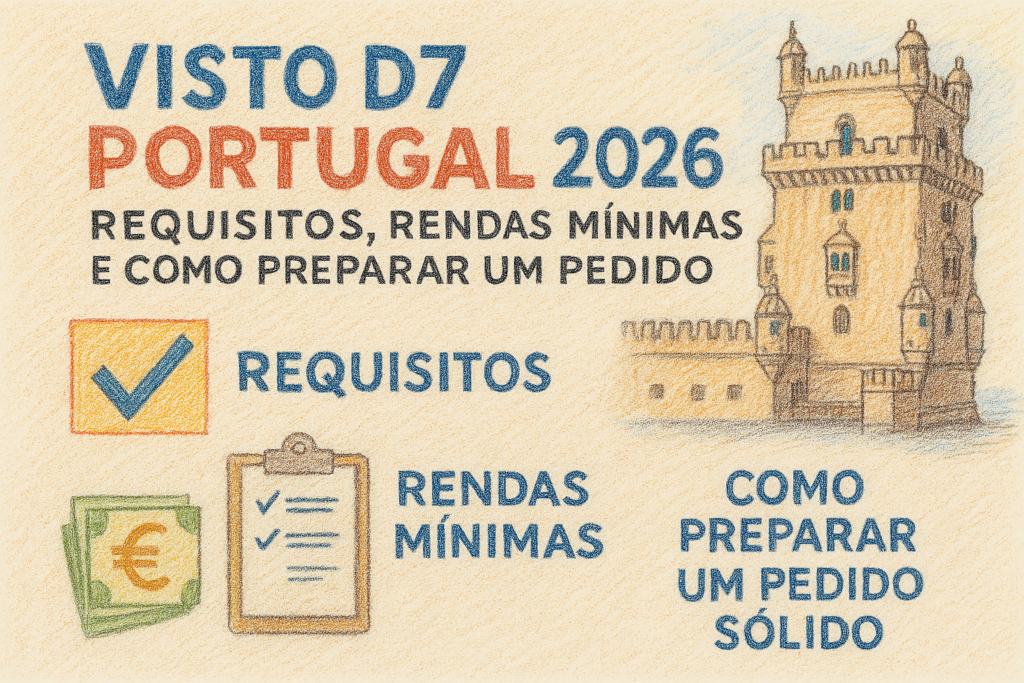
The D7 Visa—also known as the passive income visa or own‑income visa—remains, in 2026, one of the most popular pathways for legally residing in Portugal based on stable income earned abroad.
Despite its growing popularity, the process has become more technical in recent years due to increases in the Portuguese minimum wage, stricter proof of means requirements, and reinforced scrutiny by consular authorities and AIMA.
At FA ACCOUNTING, we frequently assist clients who face uncertainties regarding financial requirements, necessary documentation, and the ideal strategy for approval. A poorly structured application can lead to delays, additional information requests, or even refusal.
This article explains how the D7 Visa works in 2026, the updated income thresholds, which income sources are accepted, the documentation required, and best practices to prepare a strong and successful application.
What is the D7 Visa?
The D7 Visa is intended for non‑EU/EEA/Swiss citizens who wish to reside in Portugal and who can demonstrate their ability to sustain themselves through stable, sufficient income without depending on local employment.
In 2026, it continues to be suitable for:
- Retirees receiving pensions from abroad;
- Investors or property owners earning rental income;
- Holders of dividends, interest, royalties, or other stable passive income;
- Remote workers or freelancers with consistent income earned outside Portugal.
Essential Requirements for the D7 Visa in 2026
✔ Minimum monthly income
- €920 per month for the main applicant;
- 50% of this amount for a spouse;
- 30% for each dependent.
✔ Stability and consistency of income
Authorities expect regular bank statements, consistent tax documentation, and no unexplained account movements.
✔ Proof of accommodation in Portugal
A rental contract, property deed, or valid invitation letter is required.
✔ International health insurance
✔ Clean criminal record
✔ Minimum annual stay
Applicants must reside in Portugal for at least 183 days per year.
Eligible income sources for the D7 Visa
- Public or private pensions;
- Rental income from property;
- Dividends, interest, and financial investments;
- Royalties and intellectual property income;
- Remote income, provided it is stable and well documented.
Required documentation in 2026
- Valid passport;
- Completed application form;
- Proof of income;
- Recent bank statements;
- Proof of accommodation in Portugal;
- Health insurance;
- Criminal record certificate;
- Statement of commitment to comply with residency requirements.
Common reasons for refusal in 2026
- Insufficient or unstable income;
- Unexplained financial movements;
- Inconsistency between declared income and lifestyle;
- Invalid or insufficient accommodation proof;
- Incomplete documentation.
How to effectively prepare your D7 Visa application
- Organize financial documents well in advance;
- Ensure consistency across all documentation;
- Secure accommodation before applying;
- Seek professional guidance when necessary.
How FA ACCOUNTING can help
FA ACCOUNTING supports individuals and families throughout the financial and immigration process, from eligibility assessment to post‑arrival assistance in Portugal.
Prepare your move to Portugal in 2026
📞 Contact us today for personalized assistance.
Note: This article is for informational purposes only and may be affected by future changes in immigration law.