
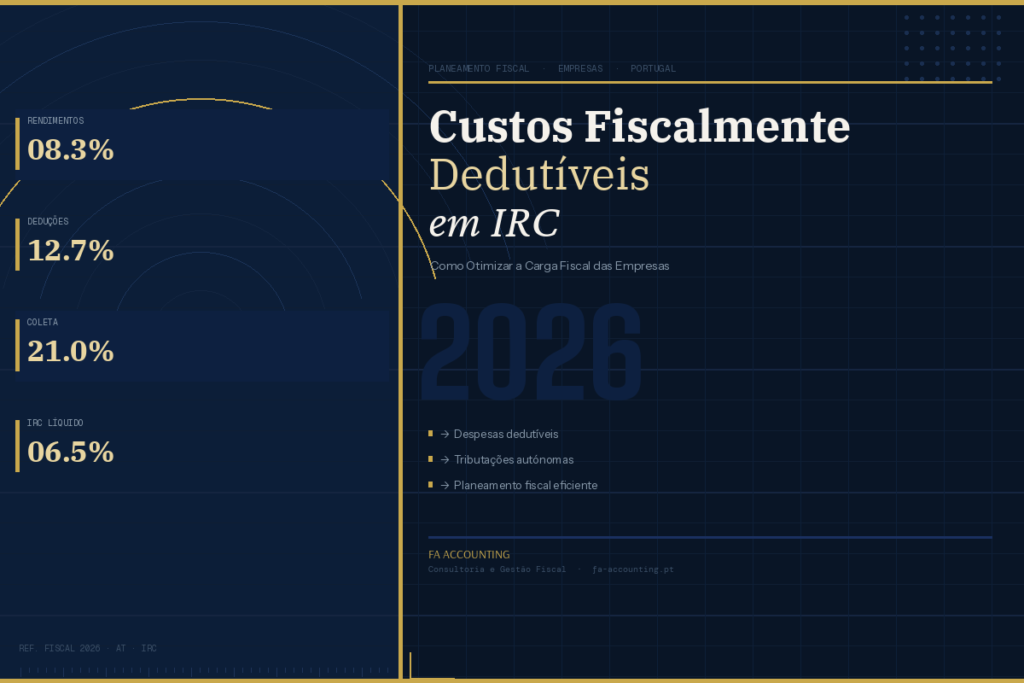
The Corporate Income Tax (IRC) regime continues, in 2026, to be one of the central pillars of corporate tax management in Portugal. Correctly identifying and categorising tax-deductible costs is essential to reducing the taxable base and, consequently, the amount of tax owed.
Although the basic rules remain stable, practice shows that many companies continue to face difficulties in the concrete application of legislation, especially given the Tax Authority’s (AT) increased scrutiny of certain categories of expenses.
At FA ACCOUNTING, we deal with these situations on a daily basis and know that incorrect classification of costs can result not only in additional tax, but also in tax corrections, compensatory interest and fines. In this article we explain the legal framework in force in 2026, the main deductible and non-deductible costs, and how to structure an efficient tax plan.
What are tax-deductible costs in Corporate Income Tax?
Under the Corporate Income Tax Code, only expenses that meet the following criteria are tax-deductible:
- Essential for obtaining income subject to corporate tax or for maintaining the company’s activity;
- Demonstrably incurred, supported by legally valid documentation;
- Correctly recorded in the accounts, in accordance with applicable accounting and tax standards.
This principle of indispensability remains fully applicable in 2026. However, the AT has been particularly stringent in analysing expenses that, although recognised in the accounts, do not show a clear link to business activity.
Essential requirements
- Direct relationship with the activity: the expense must contribute to generating or maintaining taxable income;
- Adequate documentation: complete invoices, with the company’s tax number, supplier identification and a clear description of the goods or service;
- Correct accounting record: coherent and consistent classification with the tax framework.
Examples of deductible costs in 2026
The legislation in force allows the deduction of a wide range of expenses, provided the legal criteria are met:
🔹 Personnel expenses
- Wages and salaries;
- Social Security contributions;
- Mandatory occupational accident insurance;
- Professional training costs related to the activity.
🔹 Operating costs
- Rents and charges for properties used in the activity;
- Electricity, water, gas and telecommunications;
- Office supplies and consumables;
- Services provided by third parties (consultancy, accounting, IT, marketing, etc.).
🔹 Travel and accommodation
Transport, accommodation and meal expenses, provided they are:
- Related to the activity;
- Properly documented;
- In compliance with applicable legal limits.
🔹 Depreciation and amortisation
Fiscally accepted when calculated:
- In accordance with the officially established maximum rates;
- On assets used in the business activity.
🔹 Vehicles
Costs for light passenger vehicles deductible up to legal limits, which vary according to:
- The acquisition value;
- The type of fuel or energy (combustion, hybrid, electric);
- The framework under autonomous taxation.
🔹 Provisions and impairments
Deductible only when the specific requirements set out in the Corporate Income Tax Code are met, namely regarding proof of risk or loss.
Non-deductible costs in Corporate Income Tax in 2026
Some expenses, even if recorded in the accounts, are not fiscally accepted. The main exclusions remain in 2026:
- Fines, penalties and sanctions of any nature;
- Undocumented expenses, also subject to aggravated autonomous taxation;
- Personal expenses with no connection to business activity;
- Distribution of profits or dividends;
- Costs for high-value vehicles when legally defined limits are exceeded.
The impact of autonomous taxation
Beyond deductibility, it is essential to consider the impact of Autonomous Taxation, which applies to certain expenses regardless of whether the company has a profit or a tax loss.
In 2026, the following remain covered, among others:
- Vehicle expenses;
- Subsistence allowances and representation expenses;
- Undocumented expenses.
Rates remain aggravated in cases of tax loss, especially when this is recurring, making planning all the more relevant.
How to plan deductible costs in 2026
Rigorous cost management allows you to optimise corporate tax and reduce tax risks. We highlight some best practices:
- ✔ Review of internal policies
Define clear rules for expenses, document validation and internal authorisation. - ✔ Control of vehicles and subsistence allowances
Areas frequently inspected by the AT and with a high impact on autonomous taxation. - ✔ Investment planning
Assess the timing of acquisitions and take advantage of tax benefits or more favourable depreciation regimes, where applicable. - ✔ Digitalisation and document organisation
The use of digital systems facilitates control, reduces errors and strengthens the company’s defence in the event of an inspection.
How can FA ACCOUNTING help?
An efficient tax structure is essential for the sustainability of your business. At FA ACCOUNTING, we provide continuous and strategic support to ensure that:
- Costs are correctly classified;
- Documentation meets all legal requirements;
- Corporate tax is optimised in a legal, safe manner tailored to the company’s sector.
We develop a personalised Corporate Tax Optimisation Plan, identifying tax risks and savings opportunities that can make a significant difference to the final result.
Maximise your company’s tax efficiency in 2026
📞 Contact us today for specialist advice.
Note: This article is for informational purposes only and is based on the tax legislation in force at the date of publication. It does not replace personalised advice from a qualified professional, as future legislative changes may impact the applicable regime.
Did you enjoy this article? Share it with friends and family so that everyone can benefit from this regime in Portugal!