
POINTS OF VIEW | JANUARY 2026
In an economic context marked by increasing tax complexity, technological acceleration, and ever-growing demands for transparency and rigor, Accounting asserts itself as much more than a legal compliance function; it takes on the role of a true pillar of sustainability and organizational governance.
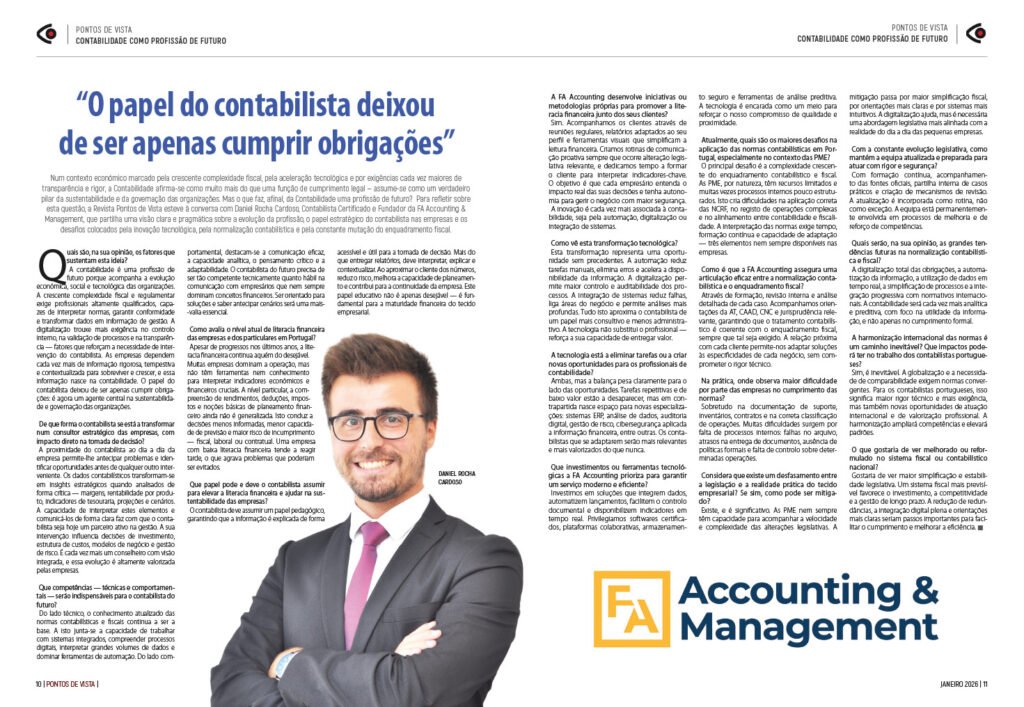
To reflect on this issue, Points of View Magazine spoke with Daniel Rocha Cardoso, Certified Accountant and Founder of FA Accounting & Management, who shares a clear and pragmatic vision of the profession’s evolution.
In your opinion, what factors sustain this idea?
Accounting is a profession of the future because it accompanies the economic, social, and technological evolution of organizations. The increasing tax and regulatory complexity requires highly qualified professionals capable of interpreting standards, ensuring compliance, and transforming data into management information. Digitalization has brought more demands regarding internal control, process validation, and transparency—factors that reinforce the need for the accountant’s intervention.
How is the accountant transforming into a strategic consultant for companies?
The accountant’s proximity to the company’s daily operations allows them to anticipate problems and identify opportunities. Accounting data is transformed into strategic insights when critically analyzed: margins, profitability per product, cash flow indicators, projections, and scenarios. Their intervention influences investment decisions, cost structures, business models, and risk management.
What technical and behavioral skills will be indispensable?
On the technical side, up-to-date knowledge of accounting and tax standards remains the foundation, along with the ability to work with integrated systems and interpret large volumes of data. On the behavioral side, effective communication, analytical capacity, critical thinking, and adaptability stand out. The future accountant needs to be as technically competent as they are skilled in communicating with entrepreneurs.
How do you evaluate the current level of financial literacy in Portugal?
Despite progress, financial literacy remains below what is desirable. Many companies master their operations but lack the tools or knowledge to interpret crucial indicators. This leads to less informed decisions and a higher risk of non-compliance. The accountant must assume a pedagogical role, ensuring that information is explained in an accessible and useful way.
How do you see the technological transformation and automation?
This transformation represents an unprecedented opportunity. Automation reduces manual tasks and eliminates errors. Technology does not replace the professional — it reinforces their ability to deliver value. Repetitive and low-value tasks are disappearing, but space is emerging for new specializations: ERP systems, data analysis, digital auditing, risk management, and cybersecurity.
What are the biggest challenges in applying standards in Portugal, especially for SMEs?
The main challenge is the increasing complexity of the accounting and tax framework. SMEs have limited resources and often unstructured internal processes, which creates difficulties in the correct application of the NCRF (Accounting and Financial Reporting Standards). There is a significant gap between legislation and practical reality. Mitigation involves greater tax simplification and clearer guidelines.
What will be the major future trends?
The total digitalization of obligations, the use of real-time data, and progressive integration with international regulations. International harmonization is inevitable due to globalization and will require greater technical rigor, but it will bring new opportunities for international practice for Portuguese accountants.